

This semester, my Readings in Genre class at Seton Hill is the Upmarket class. These are books that straddle the line (more or less) between genre and literary fiction.
First book in that class is: The Midnight Library by Matt Haig.
If you read on, there are spoilers in the review.
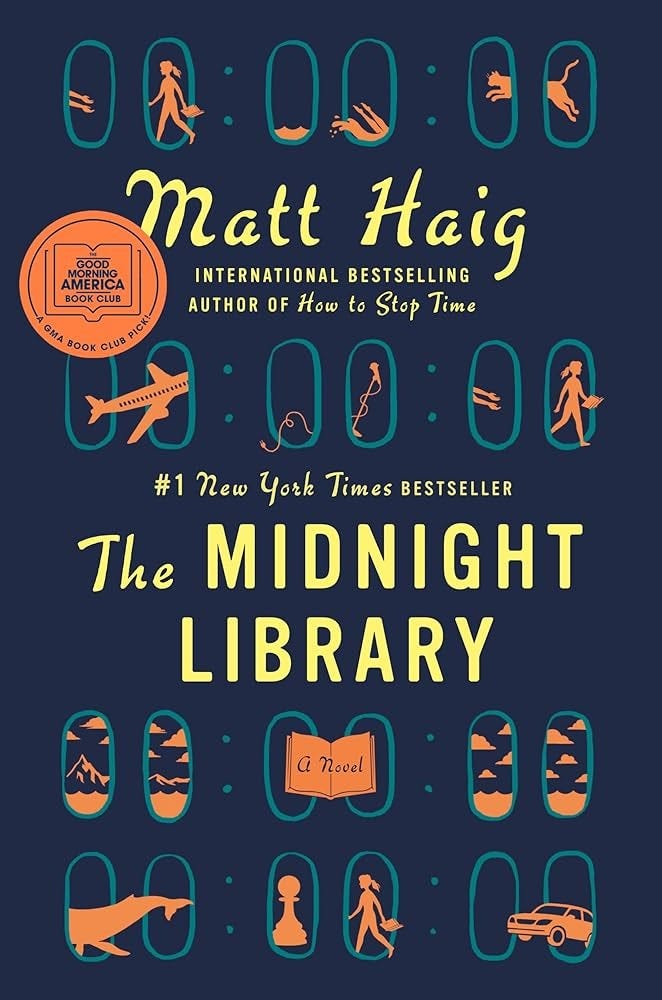
The Midnight Library by Matt Haig plays around with a familiar concept: parallel universes. Even Marvel has decided parallel and multiverses are the thing. Every choice we make sends us one way or another on a different path and creates a different life. Our past choices make us who we are.
A young woman (late 20s) named Nora Seed looks around her life and decides she wants to be dead. So, instead of dying, she finds herself in a huge library filled with an almost never-ending selection of books.
This place is the Midnight Library – a library of books that contains every path – every different life – from every decision she has ever made. Mrs. Elm is the friendly familiar librarian who explains what the library is and shows Nora The Book of Regrets she has composed throughout her life.
From those regrets, Nora has the chance to pick another life, a different book, where she chose the path not taken. When she finds a life she wants to live, she can stay. If she has doubts or questions whether she wants to be in that life, she’s returned back to the library (something she can’t control, as much as she might want to) and she cannot go back to the book/life she just left.
Time holds still in the library at midnight – and once something happens to her real body (remember she’s on the verge of dying), time will start moving and the library will be gone.
And, as you would expect, in each life she visits, Nora has something to learn. And at the end, she chooses the one I figured she would choose.
For me, the story itself was enjoyable. It’s a cute, light-hearted story — I don’t get a real sense of depth with the characters.
It’s also a pretty easy read – even if it does start with Nora learning her cat is dead. It doesn’t show the cat alive or actually die, but the cat is dead in the beginning.
Lately, I have been reminded that opening a story with wounded animals or actively-dying animals might be a turn-off to some people. While this didn’t bother me and it did have a point further in the book, I know many people who won’t read stories where (or if) an animal in the story dies. I wonder how many people who feel that way, that if an animal dies they won’t read it, how many kept reading this one?
So, it’s an interesting choice of openings for the author to make.
However, not showing (the cat) Voltaire’s death, and then using this “not showing” to make a point later was an excellent touch. Voltaire’s death served as a purposeful piece of the story and thus, maybe not as big of a deal as I sound like I’m trying to make it be?
I don’t know. But I’d be curious as to what others think.
I didn’t really worry about Nora too much. I didn’t feel worried that something bad was going too happen. I don’t feel like the story was written in such a way for me to worry about her in the beginning. While I loved the idea of “counting down” how many days and hours until Nora decided she didn’t want to live, I think that voice put me at a distance from the character.
And I have to admit, the idea of the Midnight Library and selecting choices you’ve already made to see what happens if you had selected a different one, is more interesting than this character turned out to be.
The story didn’t really grab me and put me into this world – but that’s not to say that the book wasn’t good. The story was kinda exactly what you’d expect. She chose a few lives in which things were different – and in each life, something would be different. Not just in her personal life, but in the lives of the people around her. By comparing their life in her root world to their life in the life she’s visiting, she begins to realize that she makes a difference in the lives of others by her actions. This realization is the reason she decides at the end she wants to be alive and stay in her own life.
Once the rules of the Midnight Library were established, I did have a pretty good idea of what to expect next. But I really kept reading because (besides I had to read it for class) I was curious as to how Haig was going to make this different from what has come before. What was the uniqueness that he brought to this idea?
I mean, this was my favorite theme at one point. That every event, every action you have taken, every action you have not taken – if anything had been any different than what they are, you would not be you. You would be someone else.
Part of my interest in that theme is an understanding – and a reminder – that I can’t change my past because then I wouldn’t be me. And… if I’m being truthful, sometimes I like me. I like who I am.
It’s also a desire to remind other people the same thing. Which is fine, and Haig’s novel is good. The structure of the story gives it away — and whether that’s a good thing or a bad thing can be argued about — and for me, I’d rather have expectations subverted or a surprise along the way.
I will say — all of this was written having read the book one time. So, if I did get something wrong, I’ll probably find out in our class discussion. ;) But I’ll also say, look up the page. How many words/paragraphs have I written about it? That says something.
Yeah, it was a nice story. Quick read. More popular prose than literary devices.
Matt Haig has already released his second novel, The Midnight Train, advertised not so much as a sequel, but within a similar idea – this time, your life being a train that passes before your eyes when you die. Again, great concept, right?
I would imagine it’s a very similar book in that the main character gets to go back to past events and see how they play out differently, but in the end, he wants everything to be as it was because when one thing changes, it all changes.
Because that’s what it’s supposed to be.
I’ve heard this story. Or at least, I feel like I have. I’d pick it up on sale. But I’m not sure if I would actually take the time to read it.